Majolikafabrik F. Gerbing Witwe (Gerbing & Stephan)
Bodenbach, Bohemia, Austro-Hungarian Empire (now called Podmokly, a suburb of Tetschen, now D??ín, Czech Republic).
Hersteller / Manufacturer
Prior to running his own factory, Wilhelm Leberecht Schiller (born 1797) was in partnership from 1829 with Friedrich Vincent Meinulph Gerbing (b.1798) as
Schiller & Gerbing, (S&G) in a pottery in Bodenbach. Gerbing died in 1848 and his widow Karoline, an excellent business woman, took on the running of the company. Schiller found he could not work with Karoline and left in 1850 to start his own factory, in Obergrund. Karoline continued to run the business over a period of years, suffering a series of problems due to a previous lack of factory maintenance and other issues. She had to sell many of the company assets just to stay afloat. In the meantime, Friedrich Ludwig and his wife produced a son, called Friedrich Alexander. Also Friedrich Ludwig's sister, Antonie, divorced her husband, who had been a financial drain on the family. After these difficult years, business appeared to improve slightly.
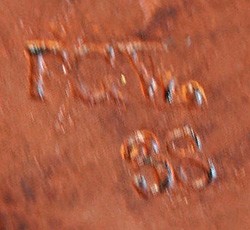
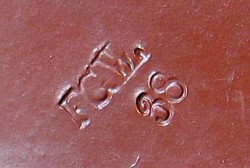
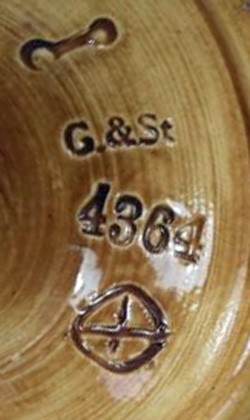
In 1859 a Prussian business man, Julius Reinhold Hermann Stephan visited looking for a business opportunity. In 1860 he invested in essential factory repairs. Subsequently Julius married Antonie, and Friedrich Ludwig and his wife had another son, Emil Alexander in 1861. So in 1861 the company became Majolikafabrik Gerbing and Stephan (using G&St. as their mark), with Stephan running the financial and sales side, leaving Friedrich Ludwig free to run the design and production. Business was excellent when Friedrich Alexander and Emil Alexander Gerbing took over the company in the early 1890's, changing their pottery marks to F&AG. In 1900 their product range was mainly historismus majolica, when the world wanted Jugendstil, so the company was forced into bankruptcy in 1903 and the factory buildings sold off. Friedrich Ludwig died in 1905, aged 77. Both brothers went on to have further careers with differing degrees of success.


 producer/manufacturer