
 Pewterer
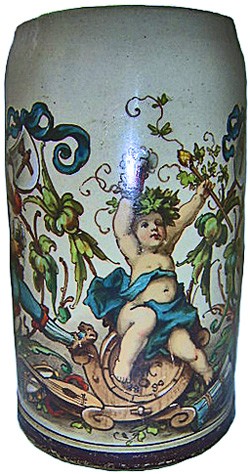
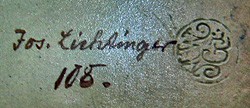
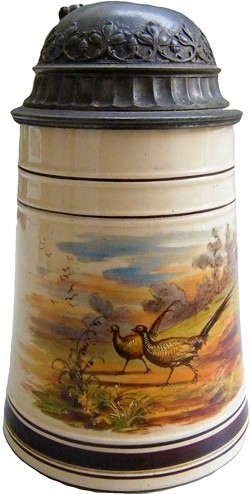
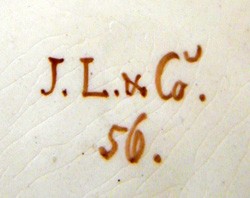
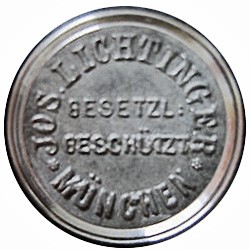
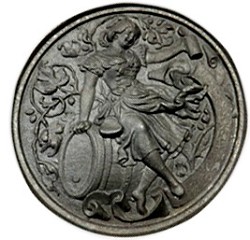
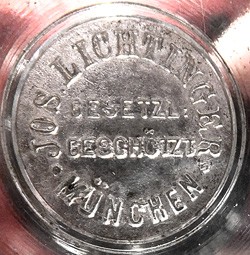
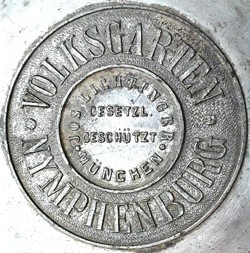
Die Zinnwaarenfabrik Josef Lichtinger & Cie.
Türkenstraße 74, Reichenbachstraße 1b, Knöbelstraße 14, Munich. Bavaria.
Zinngießerei. / Pewterer.
kgl. bayer. Hof-Kunst-Zinngusswaaren-Fabrik / House manufacturer of artistic pewter to the court of the Bavarian King.
The company was founded in 1872 or 1873 in Türkenstraße 74, by Josef Lichtinger (b.1851 - d.1900).
One of his most popular designers, was Charles Gross.
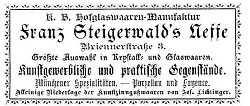
In the "Illustrirter Katalog der Münchener Jahresausstellung von Kunstwerken Aller Nationen im Kgl. Glaspalaste 1894" ("Illustrated catalogue of the Munich annual exhibition of works of art of all nations in the King's glass palace 1894") is an advertisement (see below) which stated that Franz Steigerwald's Neffe (nephew) was the sole distributor of Joseph Lichtinger's artistic pewter products.
In 1897 he bought up a large number of pewter lid moulds from the assets of the bankrupt pewterware factory, Josef Lichtinger & Cie.
By this time Löwenstein had already established a flourishing beer stein decorating business with Jakob Reinemann's
company, marketing character steins such as the "Münchner Kindl" and "Shrapnel" models, brewery steins, and many others.
From circa 1905 the company produced a range of steins based on Merkelbach & Wick blanks, using the designers of the day, i.e. Messrs Holwein, Moos and Ringer.
These were all marked , either under the handle or on the base with pen written G.Sch (Geschützt) or
M.Sch (Musterschutz).
Around 1910, Otto Löwenstein also began producing wooden toys and fashion accessories under his own name which were often based on drafts made by artists. Lyonel Feininger, for instance, designed toys and Franz Ringer bentwood boxes and "Räuchermännchen" (incense smokers) for Löwenstein. In 1914 Löwenstein sold the company "J. Reinemann" to Siegfried Berendt (1888-1947) and Lippmann Ullmann (1890-1973) but continued making wooden toys under his own name. In 1928 he moved his company called "Fa. Otto Löwenstein. Fabrik bemalter Holzgalanterie- und Spielzeugwaren" to Mauerkircherstraße 13 in the Bogenhausen neighborhood. He closed the company in 1932 and went into retirement.
Otto Löwenstein died in 1935 in Munich and was buried in the New Jewish Cemetery. Both of his sons, Alfred (1887-1964) and Karl (1888-1970), had already emigrated to the USA in 1933. Otto Löwenstein's widow, Mathilde, née Oppenheim (1868-1946), emigrated to the USA in 1936 and spent the rest of her life at her son Karl's, who was professor for law and political sciences in Amherst College, Massachusetts, United States.
Purchased stein bodies from: Merkelbach & Wick, Theresienthaler Cristallglasfabrik Regensburg.
References:
Uni-Heidelburg
Digital Bibliothek
Adressbuch München 1874
Reference: Text supplied by Bernhard Purin, Director of the Jewish Museum, Munich.